
“If you don’t have it on the ground, you won’t have it on the horse.” (Ray Hunt)
I’m not sure how many horses I’ve taken from green to (mostly) solid citizen in the fifty years I’ve had horses, more than some, far fewer than many.
During a brief time during college and for a few years after, I was a part-time professional riding instructor/horse trainer. This was borne of financial necessity and overconfidence. I quickly concluded that horse training was, for me, a better hobby than livelihood. Besides, I needed health insurance.
My Jigsaw Puzzle Approach
I think we all have philosophies that frame how we work with our horses. Here are some of mine — with no implied endorsement, that will lend some insight into my journey with Atticus:
- I often say that horses are like jigsaw puzzles. Some are more complicated; others are simpler. Regardless, it’s our task to dump out that box of pieces, sort them, start piecing them together, trying and retrying, finding a piece we missed that somehow makes everything easy for a while, taking a break, starting again.
- I’m a “pennies in a jar” girl. (More on that soon.)
- If I’m going to make an error in progress, I’m all for slower rather than faster.
- I make mistakes training all of my horses. I try to avoid repeating past mistakes, and make new mistakes with each one. I declare this “progress”.
- I define success as a relationship with my horses that is largely without drama, communication which is mostly smooth, where I set us up to get things right so we can do fun and challenging things together safely.
- If I’ve had any success at all, I suspect that it is a result of setting a goal, and then persistence, paying attention, and asking for help before I actually need it. Just like life in general.
- I’m pretty risk-averse. My ‘oh shit strap’ really helps me be brave, as does the company I keep.
- I’m not formulaic. I don’t have a schedule or spreadsheet or charts, but I do have friends who use those with great results. I will occasionally use an index card or a post-it note to jot some ideas or reminders.
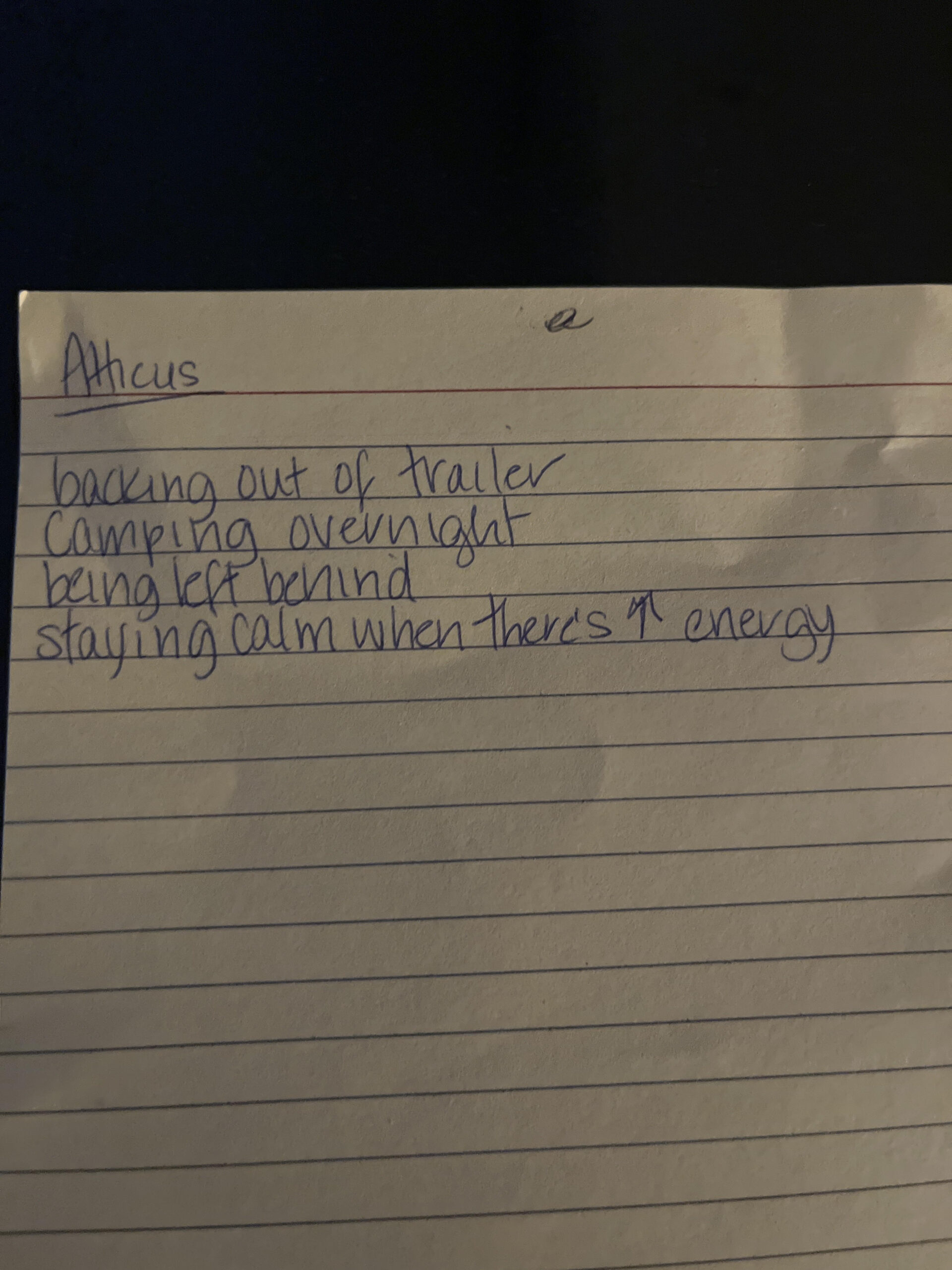
Yep. My whole life is mapped out on random post-it notes and index cards.
The Jigsaw Puzzle/Dumping the Box
Let’s take a look at the strengths and gaps I was aware of when Atticus arrived in October and those I’ve discovered since then:
- Atticus, at 7 years of age, has had a job. He is an experienced driving horse, not only in a single hitch, but doubles and four-in-hand.
- This means my guy is pretty “broke” in the best cowboy sense of the word. He’s been tied and trailered and been around events with some ‘electricity’ – like shows and fairgrounds. He has a solid foundation, for which I’m grateful. It makes both of us safer.
- His owner, Becca, was happy to tell me about Atticus’ gifts and the areas where he might present some challenges, and so far, I find myself smiling and nodding when something I discover aligns with what she told me. These included:
- ‘He needs a job.’
- ‘He will definitely test you.’
- Atticus was green under saddle. He could steer; he would stop with a snaffle bit. He was not cold-backed or squirrelly; he was just uneducated about seat and leg aids (having been used almost exclusively for driving).
- For my part, I was decidedly unfit. I was just returning to “normal” after fractures to my back, and I hadn’t ridden for about six months. I had a bit of healthy anxiety about climbing aboard a greenie and setting off on our adventure, but I was also amped as could be about taking on a new project.
The Jigsaw Puzzle/Sorting the Pieces
After a week or so for Atticus to settle in, it was time to get to work.
My dressage saddle fit Atticus well enough to do a little toodling around until the saddle fitter could come out, so I tacked him up, and fitted him with a snaffle that most closely resembled what he’d had in his former life.
And off we went. We walked around the yard, played with some circles, asking him to bend or flex or move away from my leg, I tested the various buttons. I tried to determine:
- The questions to which he knew and was willing to answer ‘yes, ma’am’
- The questions to which he didn’t know the answer and was making an effort to figure it out without any overt resistance
- The questions to which he was debating the answer but thought he was in a better position to make the decision than me
“Horses never lie.” (Mark Rashid)
It clear that Atticus is sweet and kind and loves to be told he’s a “good boy.” (As a driving horse, he relied heavily on his handler’s voice, and I found that tool in my toolbox invaluable.)
The Jigsaw Puzzle/Building the Frame
I added items to our ‘to do’ list. We started with the most basic of basics – groundwork.
Atticus was not a fan of being still. Not at the mounting block. Not when asked under saddle to simply stop and stand. Not when there was some energy in the air. Not when he was chewing on the answer to a question, and he felt one of his options was to get a little pushy. He had a lot of “ants in his pants.” This was going to be one of our first priorities.
I’m a big fan of horses who will stop and stand still. When the going gets rough, it is one of the safest lessons you can teach a horse. It’s hard to get badly hurt when the horse has all four feet planted, and it often buys crucial time to decide the next step. I wanted him to feel safe being still, staying with me until we agreed on the next move.
Like any green horse, Atticus needed some boundaries. He reminds me of an overgrown pony in many respects. He’s highly food motivated, he could plant his feet when asked to pick them up, and he was bold about encroaching on my space or swinging his big ol’ head around mine with great nonchalance. He has lots of ideas and opinions, and is happy to share them, which never fails to make me laugh.
When he gets tense, he stiffens up in a way that is unmistakable. Ample time to prepare for some reaction. A gift, really.
[There are a couple of other things that I’ll focus on in my next blog about biomechanics and teaching Atticus to use his body and placing his feet – so stay tuned.]
The Jigsaw Puzzle/Filling in the Pieces
With all of that in mind, Elise and I set to work putting “pennies in a jar.” We invested time and clarity on the basics, confirming Atticus understood and had those lessons solidly understood before moving on to others. Particularly those which could test our relationship, and therefore remove pennies from the jar. You never want to run out of pennies.
First mission, standing at the mounting block. This didn’t take long, but it did take persistence and a pretty clear goal.
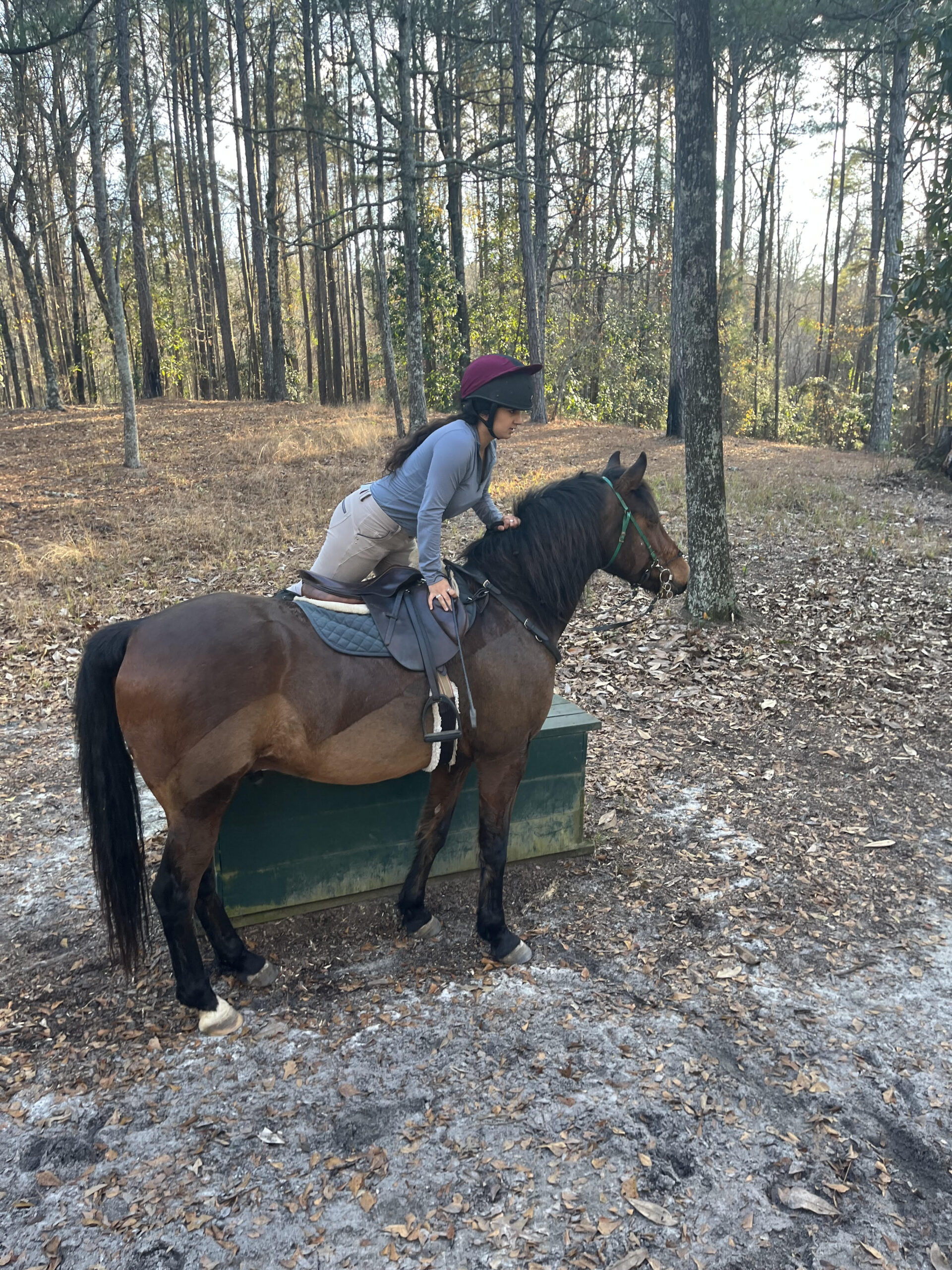
Standing still to be mounted, even if there’s something we see off in the distance in the Woods.
We started with trying to capture a ‘still’ moment to mount, then correct him as he stepped off, two or three or four times back to the mounting block until we got a good –if not perfect– answer. We’d catch him in a still moment post-mount, offer a cookie from the saddle, and always, tons of “good boys” and neck scratches and rubs.
Then we raised the bar a bit, waiting for a more solidly planted Atticus at the mounting block, mounting and then rewarding a long, relaxed lack of motion with a cookie and more praise/rubs.
After a week or so of consistent performance with cookie delivery, we started backing off on the cookies –Atticus, the oversized pony, can be a little distracted by the treats– and relying only on the verbal praise and enthusiastic all over rubs.
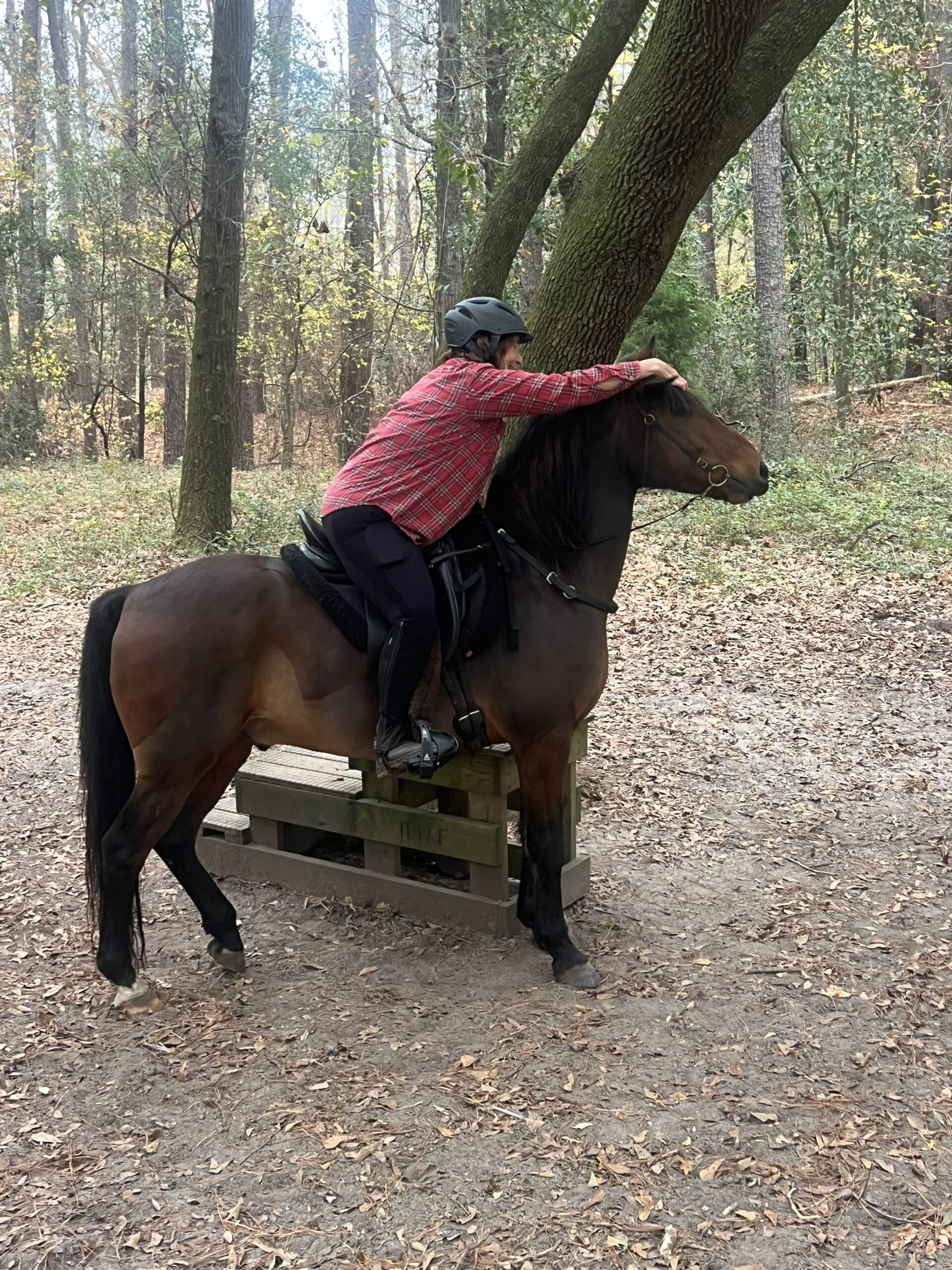
Head rubs and lots of lovin’. As good as cookies? Maybe not, but still pretty good!
He gets a cookie randomly now, but the behavior is rock solid.
We put a whole lot of pennies in the jar with that one. He learned that being still was a good thing, and that he could be safe with us being still, even when it was his first instinct to move his feet.
Make the right thing easy and the wrong thing difficult. (Buck Brannaman, inspired by Ray Hunt)
A parallel mission, self-loading in the trailer. Atticus had been led into the trailer, then tied, and he was a good compliant boy with this approach. I typically avoid being in the tuna-fish can with the horses if I can, so I wanted to teach him to self-load.
This meant ground work to establish the request to a new question – lead line tossed over the back, “walk on.”
If there was resistance or lack of understanding, we went back to the basics. No, you can’t swing your big ol’ pony head into my space. No, you can’t walk over me. Yes, you have to try to answer the question. Yes, your job is to stay in the trailer until you’re asked to back out. If you back out before you’re asked, you’ll be asked to go right back in. It only took a couple of sessions before he was reliably, and enthusiastically, jumping into the trailer.
We had a few backslides when I thought I had this one locked and loaded, almost always when there was some energy in the air. But the resistance was minimal and quickly corrected when we go back to the basics, and re-affirm the boundaries. Always praise. Sometimes cookies when I go around and connect his trailer tie. Always good hay in the trailer so it’s a pleasant place to be.
If it seems like the focus was on groundwork basics to start, you’d be right.
“If I can’t control the feet on the ground, I won’t control them in the saddle.” (Buck Brannaman)
Catch him doing something right. Praise it. Be quick to stop asking when you get an answer to a question that you like. Be firm and fair about rude behavior. Once he’s catching on to what’s right, make the cues more and more subtle.
The Jigsaw Puzzle/Mistakes Will Be Made
My whole mission is to guide this tendency-toward-tank boy to become as light and sensitive as he’s capable of being. I’ve had to shout a couple of times, but the trick is to stop shouting and get him to listen when I whisper.
On a touchier subject, perhaps, some behavior is non-negotiable.
Atticus learned that while I was a pretty benevolent dictator, I was going to enthusiastically correct rudeness or dangerous conduct—
I’ve only had to do this a handful of times, so I suspect it’s made a bit of an impression. Let’s face it, if you are always shouting at a horse, they just stop listening.
The first time or two was when he was pushy or grabby at feeding time. When he tried to “help” me load hay into the hay net, I tried whispering and using my body language to demonstrate “my space/your space”. When that didn’t work, I just allowed my elbow to meet his jaw when he encroached, followed by a sharp “no”! Then I pretended it never happened. Message quickly received; now I can whisper by standing boldly, shoulders back, in my place, and he politely maintains a foot or two of distance until my task is done.
Once, after riding with Kathy without Dunkin as a chaperone, Atticus was tied to the trailer, head up, distracted by activities on a neighboring farm. It was a warm day, he was sweaty and I was sponging him down. I reached his hind leg, applied the sponge, and he lifted a hind foot and kicked me. Right in the boob. (I laughed with someone later, suggesting there was no body part more cushioned for such a blow.) It didn’t hurt, but it did catch me by surprise. That one got three seconds of “alpha mare outrage” – raised voice, a wallop, then nothing but a long period of sponging and a very contrite Atticus.
“I’ll be as firm as I need to be, but I won’t be any rougher than necessary.” (Buck Brannaman)
He learned that I was not going to tolerate being kicked, and I learned that if he was that amped up, I should do something to diffuse the energy and get connected BEFORE he acted out.
“Pressure is easy. Timing is hard.” (Mark Rashid)
So we are learning as we go along, and I’m attempting to be a worthy partner to this lovely horse.
“When something goes wrong, look to yourself first.” (Ray Hunt)